Showing posts with label ESL Vocabulary Instruction. Show all posts

Monday, December 28, 2015

ELL Strategy: Vocabulary Explorers

This strategy focuses on helping students acquire academic language through really getting to know the word- not just the word’s meaning, but how it is used in context. This activity gives students the opportunity to learn and apply new academic vocabulary in a rich, meaningful way.

Each student will need an index card, at least 4”x 6” or larger, and a pencil. Follow the procedure below:

  1. Introduce the word in a meaningful context. All students should hear/see the same context to begin with.
  2. Write the word and definition on the board for students to copy in the upper left hand corner of the index card.
  3. Together as a group, restate or explain the word in the upper right hand corner. Students can also use their own words, depending on level of proficiency.
  4. Work together to create a visual representation- students can use the same one or create their own that makes more sense to them. This goes in the bottom left.
  5. Finally, talk about ways that the word connects to their own personal understanding or experience. Students should fill in personal connections in the lower right corner.
Front of card
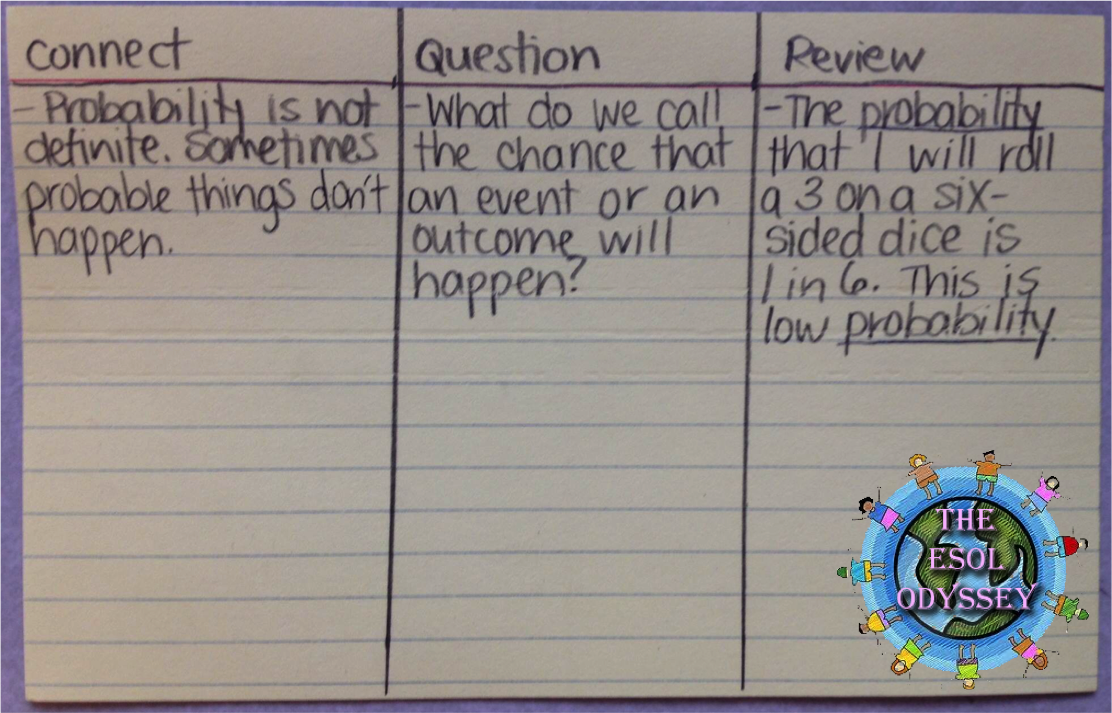
 On the back, the card should be divided into threes. As students learn more about the word or the topic, they can apply and extend their knowledge by making more personal connections, creating questions about the word or questions that the word would answer, and reviewing how the word is used in context.


Back of card
Each student then has their own vocabulary card that they can keep to support and extend their understanding of the word throughout a unit. I like to punch holes in the upper right corner and give each student a large binder ring and a small binder ring. While we are studying the unit that relates to the words, they stay on the small binder ring. When it is time to move on to a new unit, old vocabulary explorer cards are moved to the larger binder ring with other words learned throughout the year.


Thursday, March 5, 2015

ELL Strategy: Sentence Builders

This quick ELL strategy is effective at helping students use academic language in context while reinforcing their understanding of content concepts. This strategy assists students in linking related content words to construct sentences that are complete and correct content-wise.

How to:
1. Write 4-9 content-related words on sticky notes and create a grid (2X2 for four words; 3X3 for nine words)
2. Have students work in pairs to select three words across, down, or diagonally and construct a sentence.
3. Remind students to check that the sentence is complete, the information is factually correct, and if writing, have used conventions correctly.

See the examples below:


I would love to hear how you use this in your classroom!


Wednesday, October 2, 2013

Strategy of the Week: Personal Word Walls

As teachers, we know that every student is different with different strengths and weaknesses. Therefore, we know that when it comes to acquiring vocabulary, especially academic vocabulary, every student has different needs. Some need help understanding the meanings of academic words, others need help using them correctly in context, and some students need practice with words longer than others.

With all this in mind, when I was in the classroom, I helped students create their personal word walls. The idea was for them to have their own personal word wall for each subject that they could carry with them all the time. The great thing about personal word walls is that they can be differentiated for students at different levels.

So, how does one construct these personal word walls? All you need is two manilla file folders, a three hole punch, and some sticky notes. Slip one folder right inside the other, and punch your holes. I let the kids decorate the outside, and then on the inside, we label the pages with the subjects they study at school. When it is time to add a new word, kids take three sticky notes.  For newcomers, a picture, word, and simple sentence frame is often sufficient. For more advanced learners, the word, a definition, and a sentence frame or example sentence is great.

Put the sticky notes on the correct subject page, and voila- word wall. The kids can even use the holes punched to keep it inside their binder so that they always have it. Since the ids are adding the words themselves, it gives them practice with the words and ownership of their word wall. Here are some photos:


Wednesday, September 19, 2012

Mathematics Vocabulary for ELLs (and a FREEBIE)


In the past, many English Language Development Standards focused primarily on social and instructional language. Once students had mastered this type of language, it was presumed that they were able to keep up in content classes.

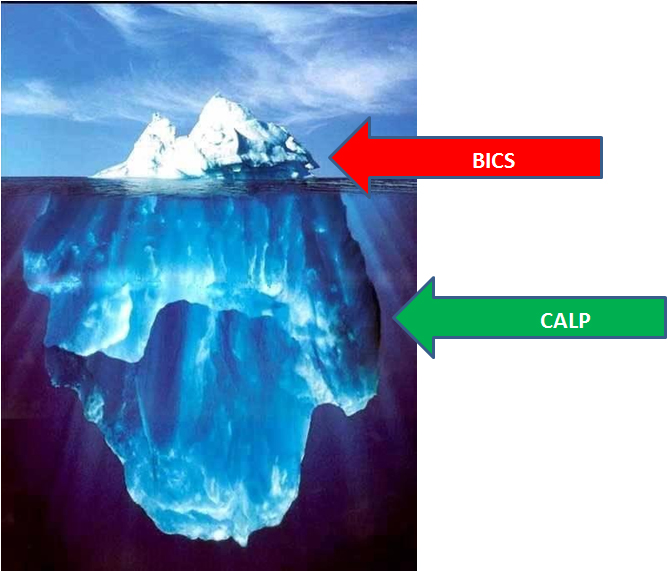
These days, we know better. Research tells us that there are two types of language proficiencies that we use on a daily basis- Basic Interpersonal Communication Skills (BICS) and Cognitive Academic Langauge Proficiency (CALP). We know that BICS are only the tip of the iceberg, so to speak. Mastery of these skills does not indicate mastery of CALP, which is what students need to be successful in their content area classes.


Students need to  be repeatedly exposed to the vocabulary and language they are expected to use, be explicity taught the academic language, hear the academic language used in the proper context, and use the academic language themselves. How on Earth can we accomplish all of this?

You'd be surprised at how easy it is to sneak a vocabulary lesson into a content lesson. Students can acquire the language and content  simultaneously if the activity is constructed properly.

Recently, my students' math teacher came to me. She was concerned because she had noticed that not only were my ESOL students mixing up their operations vocabulary with the names of the symbols (ie- How did you get that answer? I plussed it), but so were the mainstream students. She asked me if I could come up with and teach a vocabulary lesson to address the problem.

I created a word wall tiles for each of the important vocabulary that I chose: addend, addition, difference, dividend, division, divisor, minus, multiplication, obelus, operation, plus, product,quotient, subtraction, sum, times. I hung these around the room and reviewed the words with students, who repeated them after me. Students then received a definition sheet with the vocabulary words missing. They did a gallery walk to complete their definitions worksheet.

 
Then, students returned to their table groups and worked together to complete a vocabulary sort:


Students really gained a lot from this activity, and I have heard them using the vocabulary correctly. Plus, how many folks know that the division symbol is called an obelus? I know 90 4th graders who do and will never forget!! You can extend this activity even farther for your low level students by having them illustrate each of the terms (they can can look at your word wall examples/pictures for ideas). 

I also created a Math Operations Read-and-Retell activity that requires students to read a short reading about the mathematical operations, symbols, and results of operations. Students write the bold vocabulary words on the right-hand side of the page, then fold the page over and retell what they read to a partner using the vocabulary words. Finally, students re-read the story and summarize it using the same vocabulary words again. 

This activity requires students to read, write, listen to and speak the vocabulary words, all in one activity. Also included is the vocabulary sort shown above! I'm making this activity available to you for just $1 in my TpT store. Just click the button below to download!


I hope these activities can help you incorporate academic vocabulary instruction into your math time to ensure the success of your ELLs and your mainstream students!

This post added to
 
onelessheadache.blogspot.com


Tuesday, April 24, 2012

Effective Word Walls: How to use word walls in your classroom

Today at my school, some of us specialists were invited to participate in a "learning walk" of our school. A learning walk is where we wander through classrooms (unobtrusively) and look at non-negotiables like classroom libraries, reading/writing folders, objectives, word walls, and then observe instruction for a short time. This is a chance for us to not only do a sort of peer feedback for our colleagues, but a chance for us to see what our school needs to work on, and for us to get to see some "what works, what doesn't work" examples.

I noticed a lot of great teaching and some great classroom organization. One thing that I noticed though, was that while almost every teacher had a word wall (our principal requires them) they weren't being used effectively. Some word walls were there, but had no words on them, some word walls looked as if a few words had been added in September, and then they hadn't been touched since. Other word walls were hard to find because they were covered up with other stuff. A few classrooms had no word wall at all.

That got me to thinking- maybe some teachers aren't sure how to effectively use a word wall to benefit their students. Maybe you do know how to use your word wall, but you just want some new suggestions. Either way- you've come to the right place to find out about word walls according to Mrs. J.

Word walls should be relevant and up-to-date.
Word walls should only include words that your students are currently learning, or words that they have to know throughout the year. When you take words off of the word wall, you can place them in another area of the classroom labeled "words we've learned" so that they are still available for a time for students to refer to. I used to use my door as a word wall graveyard. You must take off the old words to add new ones so that your word wall doesn't get too cluttered. Also, I think it goes without saying, but- you should NOT end the year with the same words on the word wall that you started with.

Word walls should be interactive. 
Word walls are particularly beneficial for students (especially ELLs), but ONLY if the students USE them! For students to use them, they should be interactive. You can achieve this in several ways. Add a picture to the word if possible. Even better, instead of just putting the word on the word wall, you can fold over a sheet of paper, write the word on the outside, and the definition on the inside, then place it on your word wall. That way when the student forgets the meaning of the word, he or she can go to the word wall and find it. Another strategy for using your word wall is to put a sentence with the word to show how it the word is used in context. 
During certain times, you may want to allow students to add words, pictures, or definitions to your word wall. They will love seeing their own work on your word wall, and it can be a GREAT vocabulary practice activity. Remind students frequently to make use of the word wall for spelling, writing and reading activities. This way it will become a habit!

Word walls should be highly visible.
Word walls don't help anyone if the students can't see them. Many of the classrooms that I was in today had word walls that were covered up with posters or other things. Ideally, a word wall should be on a bulletin board or wall a the front of the classroom, next to your whiteboard, smartboard, or wherever students most frequently focus their attention.

I hope this tips will help you to take a fresh look at your word wall! Is it time for a renovation?


Sunday, September 11, 2011

Strategy of the Week (and a freebie!)

STRATEGY-
Zip Around
This activity provides students with a chance to apply content knowledge and practice content vocabulary while developing their listening and speaking skills.
Identify the important vocabulary and facts for practice or review. Create the pattern you will use on a piece of notebook paper to ensure that you will have answers for each question and that your cards will enable you to return to the starting question. Remember that the answer should not match the question on the same card, but rather will answer the question from the card preceding it. Make sure that there is only one answer for each question included. Write the questions into the template or onto index cards.

For example one card might say: “I have soil. Who has what plants need to make their own food?” The card that follows that would read “I have sunlight. Who has the part that plants use to take water from the soil?” The third card would then read,  "I have roots. Who has the part of the plant containing the reproductive organs?"   Clearly, this strategy can be adapted for many different content areas and topics.

Print these cards out on cardstock and laminate before playing to make them last longer.
  1. Mix up the cards, and then pass one out to each student.
  2. The first student to go should not read his or her “I have”, but instead begin with “Who has….?”
  3. The student who has the answer responds with “I have….”. “Who has…?”
  4. This pattern continues until each student has read his/her answer and question and you end with the student who began.
For the FREE TEMPLATE I created, click the picture below. You can also find a ready-to-go Solar System Zip-Around in my TpT store

ENJOY!!!


Thursday, August 25, 2011

Strategy of the Week


Strategy 1-
Vocabulary Sort
This strategy is deceptively simple, and can be used for a variety of purposes:

  • Reviewing content vocabulary
  • Reviewing story vocabulary
  • Reviewing testing vocabulary
  • Reviewing parts of speech or other grammar functions
  • Practicing word families
  • Practicing Prefixes, suffixes and affixes
  • Looking at vocabulary in new ways

In order to complete this activity, you will need a list of important vocabulary and a minimum of two categories that these words can fall into.
Type the words in a large typeface and the categories in a larger, bold typeface. Cut out the words and categories, mix them up, and place them in an envelope. Give groups of students an envelope, a large piece of paper, and a glue stick, and instruct them to place the words in the appropriate categories.
For example, while reading Seedfolks by Paul Fleischman, I realized that my middle school ESL students might have difficulty distinguishing the differences between the words Italian and Italy, or knowing that a Slovak is a person. So, before reading the chapter, I had students do the following vocabulary sort (all of the words came from the chapter):

People
Places
Things
  • Italians
  • Slovaks
  • Romanians
  • Police
  • Neighborhood
  • Gibb Street
  • Mexico
  • Cambodia
  • Guns
  • Money
  • Drugs
  • Treasure

While students work, I circulate, and if I notice things in the wrong categories, I ask them to explain their reasoning. Often while talking, students will realize their mistake and are able to correct it. If possible, you can create multiple vocabulary sorts for the different vocabulary, or use the same vocabulary but give different categories to different groups.

Monday, August 22, 2011

ESOL Mythbusters

It is time to go back to school, and that means that many teachers are meeting their students for the first time. Some teachers may be surprised to learn that they have more students in their class who speak a second language in the home than they expected.

According to the National Council for Teachers of English, English Language Learners (ELLs) now comprise 10.5% of the K-12 student population. Furthermore, in grades 7-12, the number of ELLs increased 70% between 1992 and 2002. So, it makes sense to take a closer look at some of those myths about ELLs and BUST them!

Myth: A student has acquired a second language once he or she can speak it.
As I discussed in this article, there are two types of language that we acquire when learning a second language. The first is Basic Interpersonal Communication Skills (BICS), which allow us to complete everyday tasks like following directions, making small talk, and asking and answering questions. The other type of language we acquire is called Cognitive Academic Language Proficiency (CALPs). This is the type of language that allows us to be successful in a school environment- academic vocabulary and structure. Research shows that it takes approximately 1-2 years to master BICS, and 5-7 years (or more) to master CALPs. Educators must be aware of and make the distinction between the two types of language in order to properly assess their student's level of language proficiency. A good example for most teachers is to think back to your own foreign-language learning in high school or college. Unless you majored in foreign language, you likely acquired only enough of that language to be a successful tourist or at most, a conversationalist. If you were placed in an academic environment with that level of language, you would have a very difficult time, despite the fact that you "speak" the language!

Myth: Second language learning processes are the same for all students.
As teachers, we know that no two students are the same, and this goes for ELLs as well. Just because they have a common problem (a lack of English proficiency) does not mean that they all need the same materials and methods. Just as we are expected to differentiate for other students at different levels, we must also differentiate among our ELLs. Many teachers make the mistake of giving the same modified work to all ELLs in the class, regardless of their level of proficiency. This means that all of the ELLs are not having their needs met. A classroom teacher should consult with the ESOL teacher at his or her school to get copies of the results of the yearly English Language Proficiency test for each ELL in their class. If necessary, the teacher should ask the ESOL teacher to explain what the different levels of proficiency mean. Once the classroom teacher better understands the different levels of proficiency represented by the ELLs in his or her class, then he or she is better able to make appropriate differentiations to meet the needs of all ELLs in the class.

Myth: Teaching English Language Learners means focusing primarily on vocabulary.
While explicit vocabulary instruction is important and vital for English language learners, the teacher must remember that the vocabulary means nothing if the students are not able to understand it and use it in context. This means that they must also acquire the content of the subject area, and not just the vocabulary. Word walls are a great tool for newcomer ELLs, but I like to recommend sentence walls for older ELLs, especially in content area classes. Sentence walls can help ELLs put the vocabulary that they've used into the correct context and sentence structure for the content area.
  
Myth: Using strategies to help ELLs in my class will only benefit the ELLs.
The truth is that English language learners aren't the only ones struggling with reading, writing and understanding academic language- many of the native English speaking students in our schools are deficient in academic language. Using strategies and activities that help to teach and reinforce academic vocabulary and language structures will help ALL students who are behind in understanding and using academic language. 

Myth: Making modifications to lessons and classwork takes too much time.
I won't tell you that making modifications doesn't take time, because it does. However, many teachers often teach the same grades and/or classes for years at a time, and once you've modified some material- you have that modified material to make use of year after year. Some teachers become frustrated when talking about modifications because they picture themselves spending hours and hours creating special assignments for their ELL students and falling behind in creating assignments for other students. As with most things, there is a learning curve. I will say that the more you modify assignments and the better you know your students' abilities, the easier it will become to make appropriate modifications. I've written several articles about how to make simple modifications that you can read back on, but I'll quickly remind you that there are three specific ways you can modify an assignment:
  • Change the language process needed to complete the task- for example, instead of having students write a sentence to go with a picture, you might have an ELL match a picture to an already written sentence
  • Change the grouping strategy- for example, instead of having a student work independently, have ELLs work in pairs or triads, either with one another or with a native language buddy
  • Change the content delivery- for example, instead of the grade level text the rest of the class is using, ELLs might benefit from a lower-level text covering the same material, or you can change the text by simplifying or expounding the text
As always, I hope that this article helps you to better understand and serve your ELLs. If you have any questions, feel free to ask!

Thursday, June 16, 2011

"But he speaks great English! Why does he have so much trouble?"

Blame it on the BICS and the CALPS.

Oh No! More ESL acronyms!! I know many of you are rolling your eyes, because few disciplines have as many acronyms as ESL. In this case, these are two acronyms that you need to be aware of because of the very important concepts and distinctions between them.

In 1979, J. Cummins made a very important distinction between the two types of language that can be acquired. According to Cummins, these are Basic Interpersonal Communications Skills (BICS) and Cognitive Academic Language Proficiency Skills (CALPS). Both types of language skills are important for students in our classrooms.

Students need the BICS to do everyday tasks like ask to go to the bathroom, follow directions, make small talk, and interact with peers. For the most part BICS are oral, and most students seem to gain these very quickly after they leave their silent period. According to Cummins, BICS can be fully mastered in 1-2 years. But BICS are just the tip of the iceberg, so to speak.

CALPS are the language skills that students need to be successful on academic tasks in the classroom. CALPS are much more difficult to master; in fact, some native speakers are never able to fully grasp academic language. Cummins says that for a student actively engaged in learning academic language, mastery of CALPS can take 5-7 years.

So what does all of this mean to a classroom teacher? Many very good teachers make the mistake of thinking that just because a student can "speak English" or has mastered BICS, then they are proficient in English. Teachers are confused when a student who is always talking to their peers in what sounds like fluent English struggles with reading, writing, and academic content. This is because the student has not mastered CALPS. Language difficulties often go undiagnosed because many teachers are not able to make the distinction between BICS and CALPS and how they fit into a student's English language development.

One thing that I routinely notice every year when looking over my students English Language Proficiency test results (whether those results come from the Access, the ELDA or the LAS Links test) is that students always have much higher scores in speaking and listening than reading and writing. This is because these are the skills that the students use the most. They're always listening (even when we think they're not), whether it's to the teacher, a classmate or the TV. And as their teachers, we know they always seem to be speaking. This is also because these sub-tests allow the students to demonstrate their mastery of BICS.

Reading and writing however, require the use of academic language, or CALPS, which students have a much more difficult time acquiring. This is why many of the suggested strategies like word walls, sentence walls, and explicit vocabulary instruction are so important for our ESL students- it is our chance to model for them the academic language that they are expected to use. We need to not only explicitly teach the vocabulary and meaning of the words, but the structure and context of the academic language we expect them to produce. This means lots of repetition and modeling of the language of your content. It is also important to remember that vocabulary cannot be taught in isolation- it needs to be taught in context.

As I mentioned above, many native students have difficulty mastering academic language. By explicitly teaching and modeling academic language in your classroom, you will not only help ELLs, but all of your students!

Sunday, May 15, 2011

Explicit vocabulary instruction for ELLs in the content classroom


            Crow (1986) discusses two types of vocabulary knowledge: productive and receptive. According to Crow (1986), productive word knowledge is the knowledge that one needs in order to use a word when speaking or writing. Receptive knowledge, on the other hand, is what one needs to know in order to understand a word when reading or listening.
            Echevarria, Vogt, and Short (2008) further distinguish vocabulary into three key types: content words, process/function words, and words and word parts that teach English structure. Content vocabulary consists of key terms and ideas associated with a particular content area or topic being taught.  Process/function vocabulary are those words that have to do with functional language, such as language used in the classroom and words referring to language processes (discuss, summarize, debate, etc.). Finally, words and word parts that teach English structure are words which allow students to learn new vocabulary based on knowledge of English morphology, such as root words and affixes  (Echevarria et. al, 2008).
            There are several effective strategies suggested by the creators of the SIOP model (Echevarria et. al, 2008) for teaching vocabulary which can be used to increase ELLs' understanding of content vocabulary  and language:
  1. Word Sorts. During a word sort, students classify words or phrases that have been previously reviewed into categories determined by the teacher. Words or phrases can be written on sentence strips or printed singularly on a piece of computer paper.  Students can then categorize the words based on meaning, similarities in structure (ending in –tion, for example), derivations, or even sounds. To take this even one step further and facilitate the comprehension of content concepts, students can sort words by their relationship with content concepts (for example, sorting body part vocabulary by organ system).
  2. Contextualizing key vocabulary. Before the lesson, the teacher should review the reading and select a few key terms or phrases that are essential for understanding the lesson’s most important concepts. The teacher should then introduce the words or concepts to the students, defining or demonstrating each and then showing students how it is used throughout the context of the lesson.
  3. Vocabulary self-collection. Before reading, students can skim a text to locate words that are new or unfamiliar and which they perceive as essential to their understanding of content concepts. Words may be selected individually or I pairs. A class list of the vocabulary self-collection words can be maintained throughout a lesson or unit, and the list is revised and reviewed throughout. The words may also be entered into a word study notebook, and students may be expected to demonstrate their knowledge of these words through oral and written activities.  
  4. Personal dictionaries. This strategy is similar to the previous, but personal dictionaries are created and maintained as a personal vocabulary and spelling resource for individual students. Students are responsible for maintaining their dictionaries and adding new entries.
  5. Word Walls. Word walls are useful for maintaining an alphabetical list of key vocabulary. They word wall can be introduced ad referred to throughout a lesson. The word wall can be kept on a bulletin board, poster, pocket chart, or even a sheet of butcher paper. Students are encouraged and expected to use word wall vocabulary in their reading, writing and discussions throughout the lesson or unit.  Cunningham (2004) asserts that the words on the word wall should be limited to those of the greatest importance. Pictures can also be added to help ELLs make visual connections to the words they are expected to learn and use.
  6. Four-Squares Vocabulary Cards. The student makes a card by folding a piece of paper into fourths, and then folding the central corner down to create a diamond in the center of the paper. The vocabulary word is written in the central diamond, and then the other four squares contain a definition, a picture, a sentence, and synonyms for the word. The students can locate these elements on their own, or for very important vocabulary, the teacher can provide them.
  7. Word Generation. English language learners can review new content vocabulary through analogy. The teacher provides students with a root word, and students brainstorm for words that include that root word. The class should analyze the meaning of each word that is listed to figure out what the root means. If they cannot determine the meaning on their own, the teacher can give hints or explain the meaning.
  8. Word Map. Have students create a word map for important vocabulary words. The center bubble should be the vocabulary word. The teacher or the students can designate the types of words or ideas that go in second or third level bubbles. Bubbles can include words, pictures or phrases relating to the designated vocabulary word.
  9. Word Splash Posters. Students create a poster of words connected to the concept word. On a large piece of paper or poster board, students write a concept word in a box in the center. Then they take turns writing words and phrases connected to the concept word. These words can be synonyms, antonyms, examples or connecting words. Another interesting take on this would be to have students write a short summary of what they know about a topic. Have one or two computers available and have the browser pre-set to http://www.wordle.net and type in their summary. The computer will generate a word splash poster, which students can then manipulate for color, shape and font. Print these word splash posters out and hang them around the room.
  10. List-Group-Sort. Individually, students are given a few minutes to list up to seven words about a topic. Then, students form a small team and generate a new list of words with their teammates. Finally, the team decides on categories into which they can group the words, and creates a poster, grouping the words into their determined categories.
  11. Self-Assessing levels of word knowledge. As students acquire and use new vocabulary words, it is important for them to take time to reflect on their own learning and assess their knowledge of the words they have learned. They can review their personal dictionaries, classroom word walls, and vocabulary self-selection charts and rate each word from 1 to 4:
1.      I’ve never heard or seen this word before
2.      I’ve seen or heard the word before, but I don’t know what it means
3.      I dimly know the meaning of the word, and I can associate it with an idea, concept or context.
4.      I know this word very well.