Showing posts with label CALPS. Show all posts

Wednesday, September 3, 2014

The Truth About "Academic Language".

As teachers, there are a lot of terms that we throw around regularly without really thinking about what they mean. But sometimes it's necessary to stop and think about some of those terms. Often, for teachers of English language learners, one of the most used and least understood terms is "academic language". I want to take this opportunity to explore that term and what it really means.

Academic Language is more than vocabulary.
This is perhaps the most important point I can make, which is why I'm putting it first. When it comes to academic language, vocabulary is very important, but context is equally important. Some words have different meanings depending on their context.

For each content area, it is necessary to teach students the context in which they will be using academic vocabulary, and to give them opportunities to practice using that vocabulary in the proper context. In my opinion, this can best be done through the use of sentence frames. I know, sounds simple, right? It is- but you'd be amazed at how powerful it is, too.

When I would work on a new math concept with my ESOL students, I would put up a poster with sentence frames for the type of vocabulary we were using (see an example from our probability lesson below). I would introduce the vocabulary to students along with the frames. As we worked together and I modeled the concept, I made it a point to repeatedly use the vocabulary and sentence frames that I wanted them to use. Then, I would give them an opportunity to work together, and would remind them to use the words and sentences we'd been practicing. By day three of a concept, they would depend less on the sentence frames as they truly acquired the language, and by day four I could remove them completely.


Academic language can take 5-7 years to acquire.
Yes, you read that right. Often, teachers make the mistake of assuming a student is proficient based on conversations with the student or overheard between the student and his friends. The type of language required for this is much more basic than the type of language used in academic contexts. Research has shown that it can take students 5-7 years to fully acquire the academic language necessary to be successful in school.

This means that an ELL who arrives in the US and begins learning English in middle school or high school may never fully acquire academic language before graduating. Is it then, any surprise, that our English language learners have difficulty on state standardized tests?


As teachers, we must be sure to offer plenty of scaffolds and supports to help students be successful in acquiring academic language as quickly as possible. Classroom word walls, personal word walls, sentence frames and word banks are simple but powerful tools to help students acquire academic language.

Academic language must be actively and explicitly taught.
Hanging up word walls or sentence frames will do you no good alone. Students must receive explicit instruction on the words and language structures. Students must be taught to use tools like word walls and sentence frames. And even more importantly, students need to hear you use the language and know you are expecting the same from them. Remind students to use the tools you've provided by saying, "As you're talking to your partner about this problem, be sure to use the sentence frames to help you."

In addition to writing a content objective for every lesson, include a language objective that tells students EXACTLY how you expect them to use the language to demonstrate their understanding of the content. See the example below:


Use it or lose it.
In order to really acquire language- academic or otherwise, students must have plenty of opportunities to use it. They must have opportunities to use it aloud in conversations with peers, opportunities to use it in writing, opportunities to come across it in text, and opportunities to hear it from you and their peers. Without such opportunities, they may "learn" some of the language for a short time, but they will never acquire it for the long-term. Then, when state-test time comes around, they'll be at a loss.


Wednesday, September 19, 2012

Mathematics Vocabulary for ELLs (and a FREEBIE)


In the past, many English Language Development Standards focused primarily on social and instructional language. Once students had mastered this type of language, it was presumed that they were able to keep up in content classes.

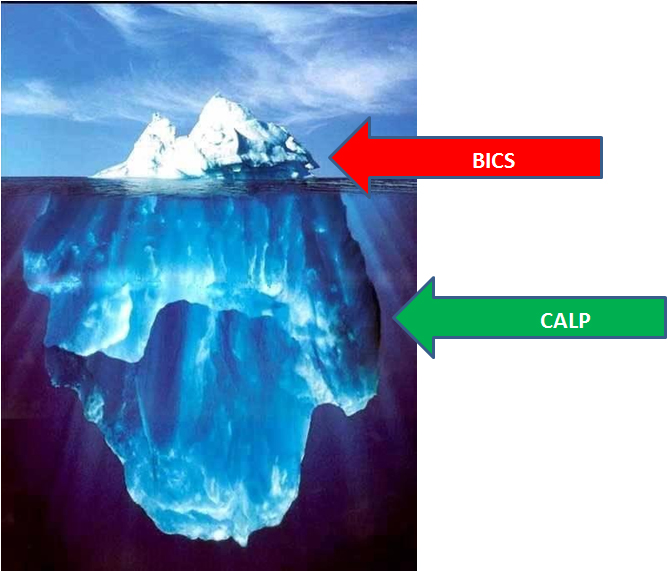
These days, we know better. Research tells us that there are two types of language proficiencies that we use on a daily basis- Basic Interpersonal Communication Skills (BICS) and Cognitive Academic Langauge Proficiency (CALP). We know that BICS are only the tip of the iceberg, so to speak. Mastery of these skills does not indicate mastery of CALP, which is what students need to be successful in their content area classes.


Students need to  be repeatedly exposed to the vocabulary and language they are expected to use, be explicity taught the academic language, hear the academic language used in the proper context, and use the academic language themselves. How on Earth can we accomplish all of this?

You'd be surprised at how easy it is to sneak a vocabulary lesson into a content lesson. Students can acquire the language and content  simultaneously if the activity is constructed properly.

Recently, my students' math teacher came to me. She was concerned because she had noticed that not only were my ESOL students mixing up their operations vocabulary with the names of the symbols (ie- How did you get that answer? I plussed it), but so were the mainstream students. She asked me if I could come up with and teach a vocabulary lesson to address the problem.

I created a word wall tiles for each of the important vocabulary that I chose: addend, addition, difference, dividend, division, divisor, minus, multiplication, obelus, operation, plus, product,quotient, subtraction, sum, times. I hung these around the room and reviewed the words with students, who repeated them after me. Students then received a definition sheet with the vocabulary words missing. They did a gallery walk to complete their definitions worksheet.

 
Then, students returned to their table groups and worked together to complete a vocabulary sort:


Students really gained a lot from this activity, and I have heard them using the vocabulary correctly. Plus, how many folks know that the division symbol is called an obelus? I know 90 4th graders who do and will never forget!! You can extend this activity even farther for your low level students by having them illustrate each of the terms (they can can look at your word wall examples/pictures for ideas). 

I also created a Math Operations Read-and-Retell activity that requires students to read a short reading about the mathematical operations, symbols, and results of operations. Students write the bold vocabulary words on the right-hand side of the page, then fold the page over and retell what they read to a partner using the vocabulary words. Finally, students re-read the story and summarize it using the same vocabulary words again. 

This activity requires students to read, write, listen to and speak the vocabulary words, all in one activity. Also included is the vocabulary sort shown above! I'm making this activity available to you for just $1 in my TpT store. Just click the button below to download!


I hope these activities can help you incorporate academic vocabulary instruction into your math time to ensure the success of your ELLs and your mainstream students!

This post added to
 
onelessheadache.blogspot.com


Tuesday, April 24, 2012

Effective Word Walls: How to use word walls in your classroom

Today at my school, some of us specialists were invited to participate in a "learning walk" of our school. A learning walk is where we wander through classrooms (unobtrusively) and look at non-negotiables like classroom libraries, reading/writing folders, objectives, word walls, and then observe instruction for a short time. This is a chance for us to not only do a sort of peer feedback for our colleagues, but a chance for us to see what our school needs to work on, and for us to get to see some "what works, what doesn't work" examples.

I noticed a lot of great teaching and some great classroom organization. One thing that I noticed though, was that while almost every teacher had a word wall (our principal requires them) they weren't being used effectively. Some word walls were there, but had no words on them, some word walls looked as if a few words had been added in September, and then they hadn't been touched since. Other word walls were hard to find because they were covered up with other stuff. A few classrooms had no word wall at all.

That got me to thinking- maybe some teachers aren't sure how to effectively use a word wall to benefit their students. Maybe you do know how to use your word wall, but you just want some new suggestions. Either way- you've come to the right place to find out about word walls according to Mrs. J.

Word walls should be relevant and up-to-date.
Word walls should only include words that your students are currently learning, or words that they have to know throughout the year. When you take words off of the word wall, you can place them in another area of the classroom labeled "words we've learned" so that they are still available for a time for students to refer to. I used to use my door as a word wall graveyard. You must take off the old words to add new ones so that your word wall doesn't get too cluttered. Also, I think it goes without saying, but- you should NOT end the year with the same words on the word wall that you started with.

Word walls should be interactive. 
Word walls are particularly beneficial for students (especially ELLs), but ONLY if the students USE them! For students to use them, they should be interactive. You can achieve this in several ways. Add a picture to the word if possible. Even better, instead of just putting the word on the word wall, you can fold over a sheet of paper, write the word on the outside, and the definition on the inside, then place it on your word wall. That way when the student forgets the meaning of the word, he or she can go to the word wall and find it. Another strategy for using your word wall is to put a sentence with the word to show how it the word is used in context. 
During certain times, you may want to allow students to add words, pictures, or definitions to your word wall. They will love seeing their own work on your word wall, and it can be a GREAT vocabulary practice activity. Remind students frequently to make use of the word wall for spelling, writing and reading activities. This way it will become a habit!

Word walls should be highly visible.
Word walls don't help anyone if the students can't see them. Many of the classrooms that I was in today had word walls that were covered up with posters or other things. Ideally, a word wall should be on a bulletin board or wall a the front of the classroom, next to your whiteboard, smartboard, or wherever students most frequently focus their attention.

I hope this tips will help you to take a fresh look at your word wall! Is it time for a renovation?


Thursday, June 16, 2011

"But he speaks great English! Why does he have so much trouble?"

Blame it on the BICS and the CALPS.

Oh No! More ESL acronyms!! I know many of you are rolling your eyes, because few disciplines have as many acronyms as ESL. In this case, these are two acronyms that you need to be aware of because of the very important concepts and distinctions between them.

In 1979, J. Cummins made a very important distinction between the two types of language that can be acquired. According to Cummins, these are Basic Interpersonal Communications Skills (BICS) and Cognitive Academic Language Proficiency Skills (CALPS). Both types of language skills are important for students in our classrooms.

Students need the BICS to do everyday tasks like ask to go to the bathroom, follow directions, make small talk, and interact with peers. For the most part BICS are oral, and most students seem to gain these very quickly after they leave their silent period. According to Cummins, BICS can be fully mastered in 1-2 years. But BICS are just the tip of the iceberg, so to speak.

CALPS are the language skills that students need to be successful on academic tasks in the classroom. CALPS are much more difficult to master; in fact, some native speakers are never able to fully grasp academic language. Cummins says that for a student actively engaged in learning academic language, mastery of CALPS can take 5-7 years.

So what does all of this mean to a classroom teacher? Many very good teachers make the mistake of thinking that just because a student can "speak English" or has mastered BICS, then they are proficient in English. Teachers are confused when a student who is always talking to their peers in what sounds like fluent English struggles with reading, writing, and academic content. This is because the student has not mastered CALPS. Language difficulties often go undiagnosed because many teachers are not able to make the distinction between BICS and CALPS and how they fit into a student's English language development.

One thing that I routinely notice every year when looking over my students English Language Proficiency test results (whether those results come from the Access, the ELDA or the LAS Links test) is that students always have much higher scores in speaking and listening than reading and writing. This is because these are the skills that the students use the most. They're always listening (even when we think they're not), whether it's to the teacher, a classmate or the TV. And as their teachers, we know they always seem to be speaking. This is also because these sub-tests allow the students to demonstrate their mastery of BICS.

Reading and writing however, require the use of academic language, or CALPS, which students have a much more difficult time acquiring. This is why many of the suggested strategies like word walls, sentence walls, and explicit vocabulary instruction are so important for our ESL students- it is our chance to model for them the academic language that they are expected to use. We need to not only explicitly teach the vocabulary and meaning of the words, but the structure and context of the academic language we expect them to produce. This means lots of repetition and modeling of the language of your content. It is also important to remember that vocabulary cannot be taught in isolation- it needs to be taught in context.

As I mentioned above, many native students have difficulty mastering academic language. By explicitly teaching and modeling academic language in your classroom, you will not only help ELLs, but all of your students!